 English
 Español





As one of the top China cardboard tube packaging manufacturers and paper tube packaging suppliers, we devote all of our efforts to research and launch more high quality packaging products to global market.
Food-grade paper converting sounds like a back-office term, but it decides whether a paper tube keeps coffee fresh, a canister protects protein powder, or a spice shaker survives a humid kitchen. The paper itself is only half the story. The other half is how it is printed, laminated, wound, seamed, sealed, and handled before it ever reaches a filling line. If you buy paper-based food packaging, understanding that chain helps you ask better questions and avoid expensive surprises.
Content
- 1 What Food-Grade Paper Converting Really Means
- 2 Start With the Paper and Barrier, Not the Print
- 3 Converting Steps That Decide Performance
- 4 Closures, Fitments, and Real-World Use
- 5 Where Food-Grade Paper Converting Often Goes Wrong
- 6 What to Ask Before You Commit
- 7 A Simple Sourcing Path
- 8 Final Thoughts
What Food-Grade Paper Converting Really Means
In simple terms, converting takes food-grade paperboard and turns it into a usable package. For flat paper, that may mean slitting, sheeting, coating, or printing. For rigid paper tubes and composite cans, converting also includes winding the board into a cylinder, sealing the side seam, laminating barrier layers, cutting to length, and fitting ends or closures. Each step can add performance, or quietly take it away.
“Food grade” is not a single stamp on a paper roll. It is a chain of controls: the incoming board, inks, adhesives, coatings, lubricants, compressed air, and operator handling. A converter can buy compliant paper and still create a non-compliant package if the wrong adhesive, inconsistent seam, or contaminated line is used. That is why a useful supplier conversation starts with the whole process, not just the paper specification. For a broader overview of rigid food tubes, our food tube packaging guide is a helpful companion.
Start With the Paper and Barrier, Not the Print
The base board should be selected for food contact and for the structural demands of the package. Virgin fiber is common in food-contact layers because it offers a clean, consistent starting point. Recycled fiber can still have a role, but it usually belongs in a non-contact layer unless the supplier can document its food-contact suitability. The next decision is the barrier. Moisture, oxygen, grease, aroma, and light do not behave the same way, and a coating that solves one problem may be unnecessary or even unhelpful for another.
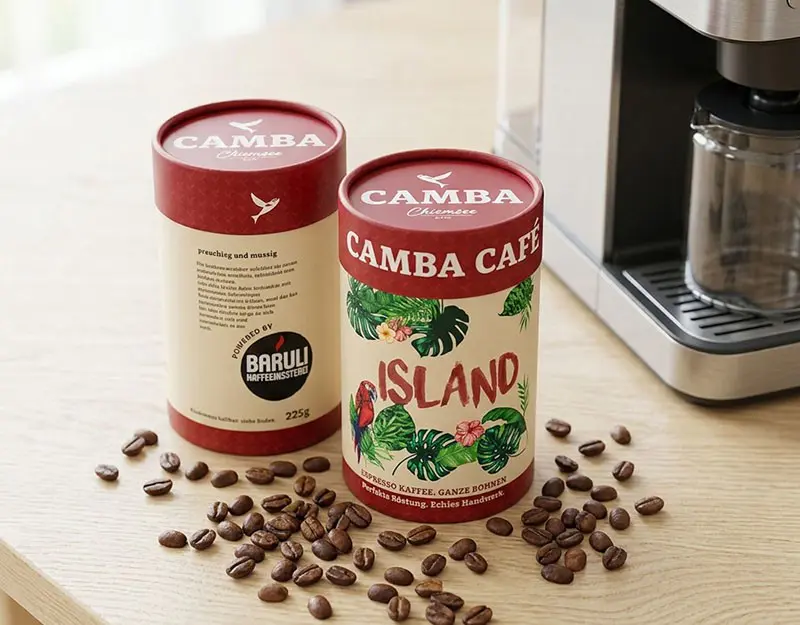
For coffee, a valve and a high-barrier structure may matter more than a heavy board. For a dry powder, a double-sealed canister with a reliable foil membrane may be the practical answer. For a spice blend, a shaker top and a grease-resistant liner might matter more than gloss. Ask your converter to match the barrier to the product’s real shelf-life test, not to a generic “airtight” label. A sample that feels tight on the desk is not the same as a package that holds up in a warehouse.
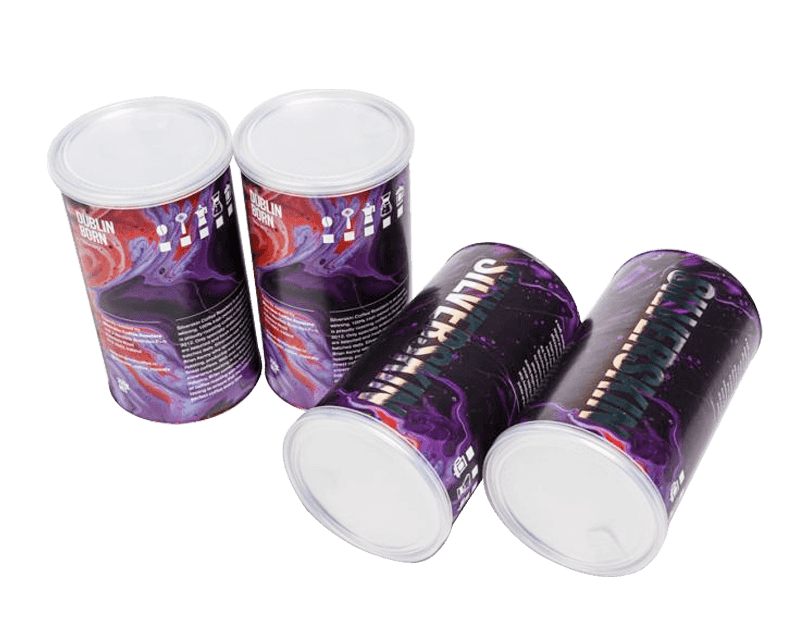 Airtight Coffee Bean Tube with Valve for 250gA foil-lined composite paper can with valve, plastic cover and tin bottom for 250g coffee beans; check barrier and filling fit.View Product →
Converting Steps That Decide Performance
Most converting problems show up at the filling line, but they begin earlier. The table below shows where a food-grade paper tube or can is most likely to gain or lose reliability.
| Converting stage | What can go wrong | What to verify |
|---|---|---|
| Printing and coating | Ink migration, poor adhesion, uneven barrier | Food-contact ink and coating declarations; cure and adhesion checks |
| Winding and side seaming | Weak seam, ovality, inconsistent wall thickness | Seam strength, diameter tolerance, board moisture |
| Laminating and barrier build | Pin holes, foil wrinkles, coating gaps | Barrier test results, bond strength, visual standards |
| Bottom and top sealing | Leaks, poor closure fit, damaged curl | Leak testing, closure compatibility, opening force |
| Cutting and finishing | Burrs, dust, dimension drift | Clean cut, dust control, final dimensional report |
In our own work with composite cans and paper tubes, the most useful quality data is often boring: seam measurements, closure fit, leak checks, and batch records. Those details tell you more than a brochure about “premium” materials.
Closures, Fitments, and Real-World Use
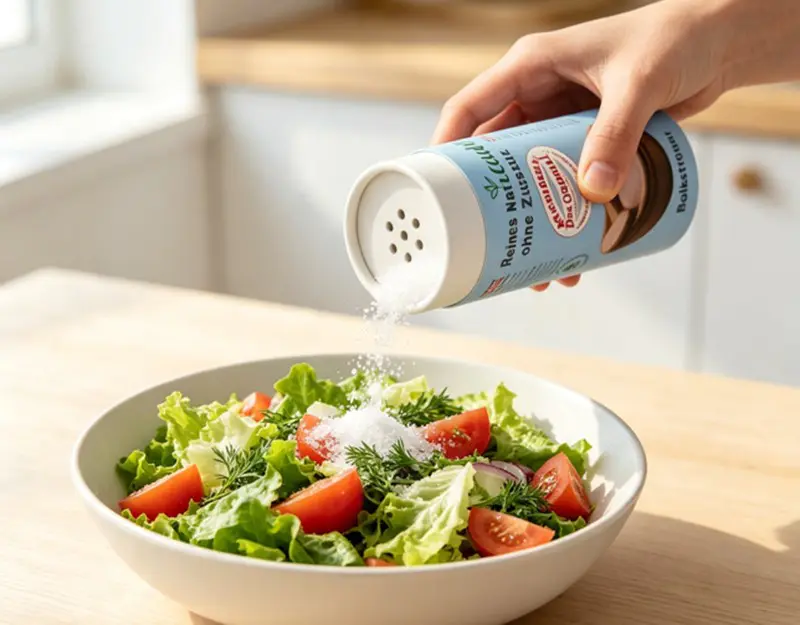
A food-grade paper package is a system. Metal ends, peelable aluminum foil, plastic shaker inserts, valves, and paper or plastic plugs all touch the product or its headspace. They need their own food-contact documentation and a real fit with the converted body. A canister that is airtight in theory but has a loose shaker insert will fail in a kitchen. A coffee tube with a valve needs the valve, membrane, and canister to work together, not as three separate purchases.
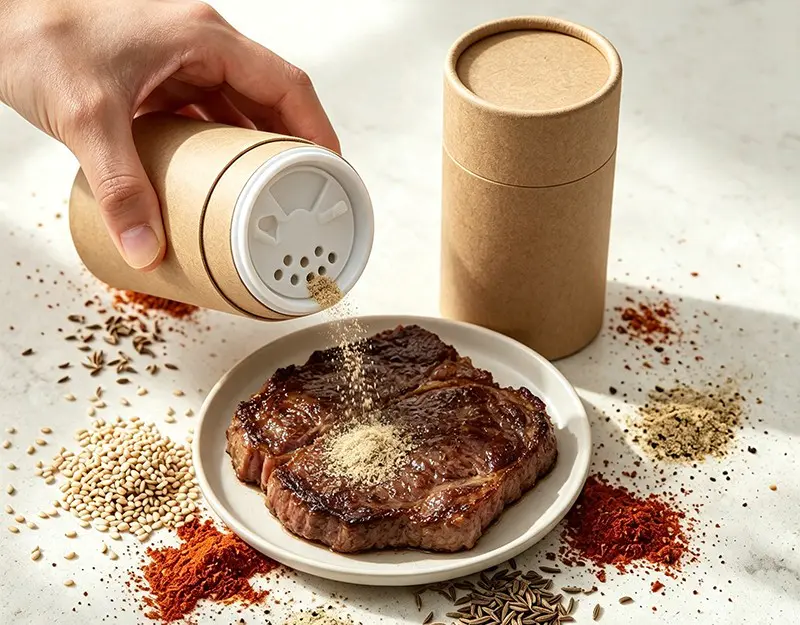
This is also where format choices become practical. A seasoning brand may need a paper tube with a controlled sift opening, while a nutrition brand may need a wide-mouth canister with a foil seal and a secure overcap. The converter should be able to discuss the filling equipment, the opening experience, and the shelf life as one problem. If a closure is added just to complete a catalog page, the package usually tells you at the first trial.
 Custom Printed Kraft Paper Tube Shaker for SpicesA 50g kraft paper spice tube with foil liner, plastic sifter lid and custom printing; suited to controlled sift openings and filling trials.View Product →
Where Food-Grade Paper Converting Often Goes Wrong
- Barrier mismatch: a moisture barrier is chosen for a product that mainly needs grease resistance, or an oxygen-sensitive product is packed in a structure with no real oxygen barrier.
- Seam and closure leaks: the body passes inspection, but the side seam, bottom curl, or closure fit is not checked as a system.
- Migration risk from inks and adhesives: the board is food grade, but the printing or laminating chemistry is not documented for the intended use.
- Dimensional drift: small changes in board moisture or winding tension create filling-line jams that look like a machine problem.
- Certificate-only confidence: a supplier has a certificate, but no batch traceability, change control, or line-level hygiene record to support it.
These issues are not exotic. They are the normal friction points of converting, and they are easier to catch with a sample trial and a clear specification than with a last-minute inspection.
What to Ask Before You Commit
Start with the food-contact declaration for every material that touches the product or headspace, including the board, coating, ink, adhesive, foil, and closure. Ask whether the supplier can provide migration test data for the intended use, a PFAS-free statement where relevant, and a description of how they control dust and foreign matter. Then ask about the line: how seam strength is checked, how closure fit is validated, and how a batch is traced if something changes.
It also helps to ask what the converter will not do. A good supplier should tell you when a proposed barrier is overkill, when a shaker top needs a different inner seal, or when a sample should go through a real filling trial before anyone talks about volume. Our own QS certification and CCTI membership are the kind of evidence worth asking for, but the paperwork only matters if it matches the production line.
A Simple Sourcing Path
The most reliable path is usually short and practical. Define the product’s worst-case exposure—humidity, heat, grease, aroma, shipping—and then ask for a material and closure recommendation. Request samples that match the intended board, coating, and print process, not a generic stock tube. Run a filling trial, check the opening experience, and store the filled sample under accelerated conditions if shelf life matters. Only then move to production drawings and batch approvals.
For dry powders and supplements, a double-sealed canister often earns its place because it separates the barrier decision from the filling and reclosing experience. The point is not to buy the most complex package; it is to buy the simplest structure that still protects the product and meets the food-contact rules.
 Double-Sealed Paper Can with Penny-Lever Lid for 150g PowderA double-sealed composite paper can with penny-lever lid and 101 mm diameter for 150g superfood powders; separates barrier protection from filling and reclosing.View Product →
Final Thoughts
Food-grade paper converting is a quiet discipline. When it works, the package feels simple: the tube opens cleanly, the canister keeps its shape, the seal holds, and the print stays where it belongs. When it fails, the cause is often a small decision made far upstream. By treating paper, barrier, converting, and closure as one system, buyers can get a package that is genuinely food-safe, practical to fill, and pleasant to use.
